A large AI system does not become scalable just because it remembers more text. It scales when its best moves can be repeated by a different agent, in a different checkout, under a real gate. That is why the unit worth packaging is a skill, not a prompt transcript.
HyperFrames-ready argument trailer
Watch the comparison in motion.
A 22-second companion for the post: current repo evidence, alternative comparisons, and the compounding curve for skill packages, now paired with an HTML-native HyperFrames source contract.
Reusable video package
The trailer is now skillable, not just rendered.
The MP4 above remains the public playback asset. The new HyperFrames source beside this post makes the same argument portable: five timed DOM clips, one seekable GSAP timeline, and a composition contract another agent can inspect before rendering or remixing.
- Composition
skillable-scalable-hyperframes- Canvas
- 1920x1080, 22 seconds
- Beats
- Thesis, evidence, alternatives, curve, handoff
- Source
- Open the HTML composition
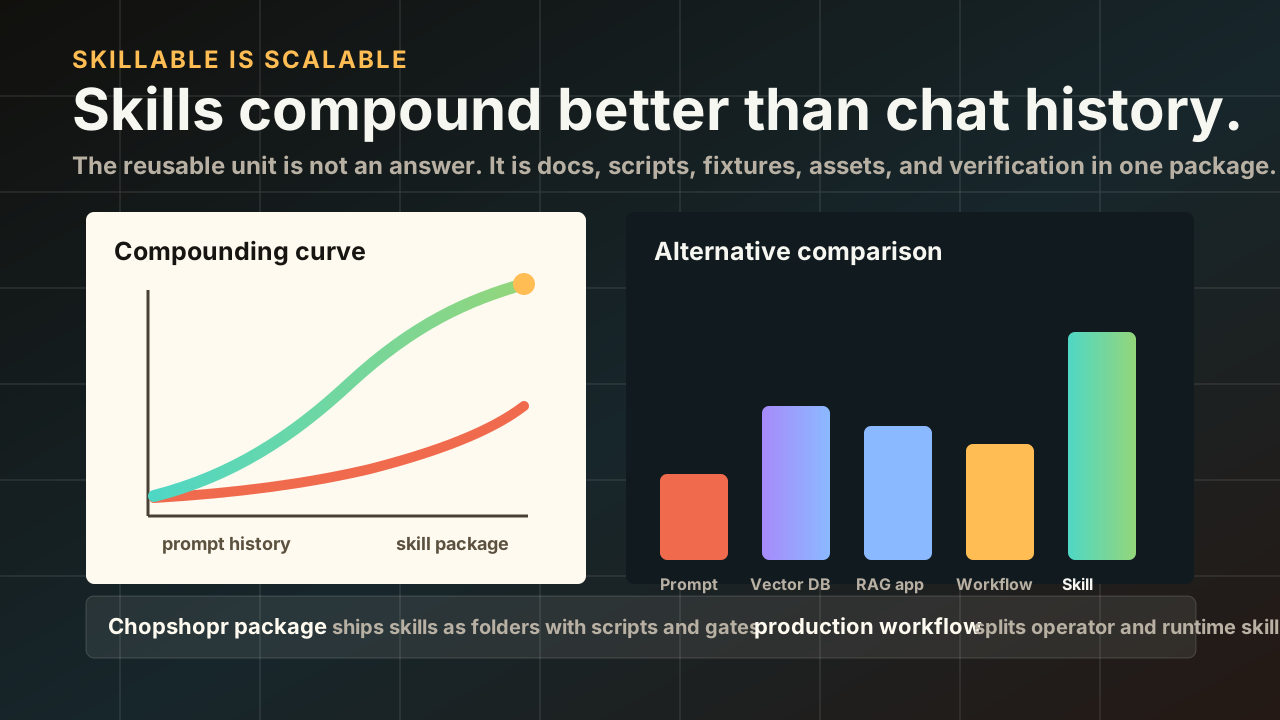
A skill is a repeatable operating surface. If the agent cannot find it, run it, test it, and hand it to another agent, the work is not scalable yet.
What the current package already proves
The Chopshopr package is not just a public site. It is a bundle of skills, scripts, static routes, Remotion assets, CDK deployment code, and build gates. Its useful behavior lives in folders: each folder has a name, a contract, helper files, and commands that can be re-run.
Chopshopr package
Skills such as charting, OpenUSD simulation, screenshot capture, UX routing, and reasoning quality ship as folders with `SKILL.md`, references, scripts, resources, evals, and visual assets.
Build receipts
`python3 -m ops.cli build` runs the worktree guard, design audit, tests, site smoke, CDK synth, timing summary, and large-file stats before a change is treated as ready.
Public artifacts
Blog posts, labs, SVG graphs, and Remotion videos are committed assets. The public route is not a screenshot of an idea; it is the artifact.
Executable knowledge
The stronger skills are not prose-only. They include commands such as `openusd:skill-check`, `chart:validate`, and `ux:blueprint` so the agent has a procedure, not a vague memory.
What the production workflow already proves
The production workflow makes the same argument from an application angle. It separates operator skills from product-runtime skills, keeps Memory Bank docs as the navigation layer, and uses `ops.cli` as the command surface for build, test, deploy, docs, and data preparation.
- Operator skills live under `.codex/skills`; runtime behavior bundles live under `backend/skills`. They are intentionally not the same thing.
- Runtime skills are allowlisted by backend code and require explicit skill names. That is how a skill stays a product behavior, not a generic shell escape hatch.
- Repo questions can use codebase search backed by `rg`, with allowed roots, file-size limits, and tight line-window reads before explanations.
- Vector search is present as an optional reference retrieval path, but the app is honest about configuration: a vector store needs IDs, routing parity, and re-indexing before it should be trusted.
Alternative comparisons
Vector DBs, RAG app stacks, and workflow automation are useful. The mistake is treating them as substitutes for packaging the way of working.
The vector DB decision rule
A managed vector database is an earned layer. Add it when the source set is too large for repeated file search, when many users need low-latency retrieval, when ranking quality has been measured, or when non-file connectors and tenant rules are part of the product. Until then, skill packaging should come first.
The reason is simple: retrieval helps the agent find context. A skill tells the agent what to do with the context and how to prove it worked.
What makes something skillable
- A trigger rule. A short activation condition that tells the agent when this package applies.
- A bounded procedure. The steps are explicit enough that another agent can follow them without reading a previous conversation.
- Progressive disclosure. The entry file stays short. Detailed references, scripts, examples, and assets are loaded only when the task needs them.
- Executable helpers. Scripts handle repeatable work better than prose. They also give tests something concrete to call.
- Verification gates. A skill is not done until the command, artifact, or test proves the package still works.
- Distribution shape. A folder with predictable files can be copied, reviewed, versioned, and mounted.
The scalability curve
Prompt history is cheap on day one and expensive by day ten. Every new agent has to rediscover the same hints, caveats, and failure modes. A skill package is the inverse: it costs more up front because someone has to name the pattern, write the helper, add fixtures, and choose the gate. After that, every reuse gets cheaper.
That is why the right question is not "do we need a database?" The better question is "can this repeated work become a skill before we scale the team, the traffic, or the number of agents using it?"
What to copy this week
- Pick one repeated workflow that currently lives in chat history.
- Create a folder with `SKILL.md`, one reference file, one fixture, and one script.
- Add a small test that proves the script or package contract still works.
- Publish the output as an artifact, not a promise.
- Only add a vector layer after a measured retrieval miss proves it is needed.